

Windows
DSPTone ExoDelay v1.0.5 [WiN]
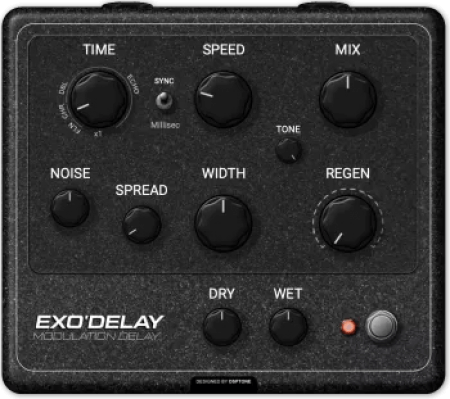
SEnki | 03 February 2026 | 18 MB
MODULATION DELAY
From vintage digital echoes to modern evolving modulation motion
Several delay eras combined into one, from tight vintage echoes to modern textures
Characterful modulation delay inspired by early digital delay designs of the 1980s and reimagined for modern production
– Vintage digital delay character.
– Modulated echoes with dynamic ducking.
– Classic ranges + modern triple delay mode
Unlike BBD, early digital units offer:
Clear repeats / Stable delay time / Modulation
However, memory was expensive and bandwidth was limited. Each generation of digital delay had its own distinct character - defined by delay time limits, filtering, noise floor, and modulation behavior. Some units focused on short, chorus-like delays. Others expanded delay time at the cost of bandwidth. Later designs pushed clarity and range further.
Digital Delay Still Matter Today
We inspired in this effect by Ibanez™ pedals (DML, DML10 & DML20) from 1980th. As well-known part of the early digital delay era *
ExoDelay captures this evolution by offering multiple delay characters, each reflecting a different design philosophy from that era - and then extends them with modern routing and control.
Shorter delay ranges encourage rhythmic playing.
Narrower bandwidth sits better in a mix.
Subtle modulation adds movement without chaos. Saturation and noise create depth and presence
DELAY MODES
Inspired by guitar fx delay pedals
Variable time range as masterpiece
Extended automatically depending on mode
Each Delay mode includes own time range. You can create effects like flanger, chorus, vibrato, doubling, snapback and echo delay lines. Sync – switching Time parameter between Milliseconds and Beats, Triplets & Dotted time-synced values.
ROUTING ARCHITECTURE
Same principles as other delays, but with added feature of modulation (LFO changes the delay time)
-> Input stage -> Pre-Emphasis stage -> Saturation stage -> Delay stage -> De-Emphasis stage -> Ducking stage -> Tone stage -> Dry & Wet Mix -> Output stage
Noise, Spread, Width & Regen time range as masterpiece
We build it with noise injection of vintage chips with saturated and bandwidth limited character. Emphasis & De-emphasis stages is also part of the device architecture. Noise adds perceived motion, improve depth illusion, makes feedback feel alive. Spread adjusts the stereo width, adds flanger effect. Regen set the amount of delayed signal fed back into the delay stage
ADDITIONAL CONTROL
AUTOGAIN: Adjusts the output level of the saturation stage to match the input level.
DUCK AMT: Amount of level reduction on the effect signal. Duration of the ducking effect controlling by the delay TIME knob.
DUCK SHAPE: Controls how smooth or sharp the ducking response is
USE FOR INSTRUMENTS PROCESSING
– GUITAR: Rhythmic delays. Modulated leads. Clean ambient textures
– BASS: Short delays with ducking. Subtle modulation for width
– SYNTHS: Animated echoes. Stereo movement. Sound design layers
– VOCALS: Tempo-synced delays. Ducking for clarity. Darker Tone settings
– DRUMS & PERC: Slapback echoes. Stereo rhythmic delays. Controlled feedback textures
home page
From vintage digital echoes to modern evolving modulation motion
Several delay eras combined into one, from tight vintage echoes to modern textures
Characterful modulation delay inspired by early digital delay designs of the 1980s and reimagined for modern production
– Vintage digital delay character.
– Modulated echoes with dynamic ducking.
– Classic ranges + modern triple delay mode
Unlike BBD, early digital units offer:
Clear repeats / Stable delay time / Modulation
However, memory was expensive and bandwidth was limited. Each generation of digital delay had its own distinct character - defined by delay time limits, filtering, noise floor, and modulation behavior. Some units focused on short, chorus-like delays. Others expanded delay time at the cost of bandwidth. Later designs pushed clarity and range further.
Digital Delay Still Matter Today
We inspired in this effect by Ibanez™ pedals (DML, DML10 & DML20) from 1980th. As well-known part of the early digital delay era *
ExoDelay captures this evolution by offering multiple delay characters, each reflecting a different design philosophy from that era - and then extends them with modern routing and control.
Shorter delay ranges encourage rhythmic playing.
Narrower bandwidth sits better in a mix.
Subtle modulation adds movement without chaos. Saturation and noise create depth and presence
DELAY MODES
Inspired by guitar fx delay pedals
- DMOD: darker bandwidth & stronger character. Rhythmic echoes and classic modulation textures.
- DMOD-10: smoother tone & balanced clarity. Melodic delays and evolving modulation
- DMOD-20: brighter bandwidth & cleaner repeats. Spacious delays and detailed modulation
- MODERN TRI: x3 Delays into one evolving delay line. Ambient effects, rhythmic complexity design
Variable time range as masterpiece
Extended automatically depending on mode
Each Delay mode includes own time range. You can create effects like flanger, chorus, vibrato, doubling, snapback and echo delay lines. Sync – switching Time parameter between Milliseconds and Beats, Triplets & Dotted time-synced values.
ROUTING ARCHITECTURE
Same principles as other delays, but with added feature of modulation (LFO changes the delay time)
-> Input stage -> Pre-Emphasis stage -> Saturation stage -> Delay stage -> De-Emphasis stage -> Ducking stage -> Tone stage -> Dry & Wet Mix -> Output stage
Noise, Spread, Width & Regen time range as masterpiece
We build it with noise injection of vintage chips with saturated and bandwidth limited character. Emphasis & De-emphasis stages is also part of the device architecture. Noise adds perceived motion, improve depth illusion, makes feedback feel alive. Spread adjusts the stereo width, adds flanger effect. Regen set the amount of delayed signal fed back into the delay stage
ADDITIONAL CONTROL
AUTOGAIN: Adjusts the output level of the saturation stage to match the input level.
DUCK AMT: Amount of level reduction on the effect signal. Duration of the ducking effect controlling by the delay TIME knob.
DUCK SHAPE: Controls how smooth or sharp the ducking response is
USE FOR INSTRUMENTS PROCESSING
– GUITAR: Rhythmic delays. Modulated leads. Clean ambient textures
– BASS: Short delays with ducking. Subtle modulation for width
– SYNTHS: Animated echoes. Stereo movement. Sound design layers
– VOCALS: Tempo-synced delays. Ducking for clarity. Darker Tone settings
– DRUMS & PERC: Slapback echoes. Stereo rhythmic delays. Controlled feedback textures
home page
Only registered users can see Download Links. Please or login.
No comments yet