

Windows
Okmog Gyrator X v2.0.2 [WiN]
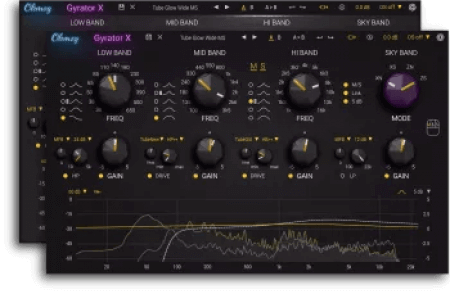
SEnki | 19 February 2026 | 10.4 MB
A Physics-Driven Equalizer Derived from Real Circuits
From the Physicist's Bench to Your DAW
For decades, digital equalizers have attempted to recreate the sound of analog hardware - yet something essential has often been missing: the physical interaction between components that gives real circuits their depth, motion, and musical response.
Gyrator X was created to solve exactly that.
Developed by physicist, circuit designer, and producer Oliver Gretz, Gyrator X does not use standard DSP methods. It is a topology-preserving, physics-based emulation of full analog circuits, modeled at the component level and brought to life through years of research, measurement, and listening tests.
The result is an equalizer that responds organically, feels musical, and integrates naturally into professional mixing and mastering workflows.
“Curve accuracy was never enough. I wanted the responsiveness, interaction, and musicality that only real circuits provide. Gyrator X is the result of years of research into how those circuits truly behave.”
- Oliver Gretz, PhD
Key Features
Gyrator-Based Equalizer Core
Signature Sky Band
Advanced Filter Section
Multiple Feedback (MFB)
Sallen-Key (SK)
State Variable (SVF) (including true 4-pole SVF)
Passive high-pass design
A proprietary Gyrator-based low-pass
Dual ADAA Saturation Stages
Available saturation models include:
Modern vacuum tube
Vintage NOS tube
Silicon and germanium transistor stages
Silicon and germanium diode circuits
JFET class-A stage
Each stage can be freely positioned within the signal path, allowing precise tonal shaping before or after EQ stages.
Precision Workflow & Control
Fully Interactive Interface
Advanced Control Features
Spectrum Analysis & Visualization
home page
From the Physicist's Bench to Your DAW
For decades, digital equalizers have attempted to recreate the sound of analog hardware - yet something essential has often been missing: the physical interaction between components that gives real circuits their depth, motion, and musical response.
Gyrator X was created to solve exactly that.
Developed by physicist, circuit designer, and producer Oliver Gretz, Gyrator X does not use standard DSP methods. It is a topology-preserving, physics-based emulation of full analog circuits, modeled at the component level and brought to life through years of research, measurement, and listening tests.
The result is an equalizer that responds organically, feels musical, and integrates naturally into professional mixing and mastering workflows.
“Curve accuracy was never enough. I wanted the responsiveness, interaction, and musicality that only real circuits provide. Gyrator X is the result of years of research into how those circuits truly behave.”
- Oliver Gretz, PhD
Key Features
Gyrator-Based Equalizer Core
- Low, Mid, High Bands modeled from analog gyrator circuits
- Authentic analog component interaction
- Carefully tuned frequency ranges and Q values for musical shaping
- Independent Mid/Side or Left/Right operation
Signature Sky Band
- A proprietary high-frequency shaping design delivering open, airy enhancement without harshness
- Multiple response modes allow subtle sheen or extended brilliance without unnaturally changing the spectral balance
Advanced Filter Section
- High-Pass and Low-Pass Filters modeled from classic analog circuits
- Multiple circuit types, including:
Multiple Feedback (MFB)
Sallen-Key (SK)
State Variable (SVF) (including true 4-pole SVF)
Passive high-pass design
A proprietary Gyrator-based low-pass
- True circuit-dependent behavior
Dual ADAA Saturation Stages
- Two fully independent saturation stages using anti-derivative anti-aliasing (ADAA), with multiple models derived from detailed measurements of analog circuitries for precise harmonic control.
Available saturation models include:
Modern vacuum tube
Vintage NOS tube
Silicon and germanium transistor stages
Silicon and germanium diode circuits
JFET class-A stage
Each stage can be freely positioned within the signal path, allowing precise tonal shaping before or after EQ stages.
Precision Workflow & Control
Fully Interactive Interface
- Dual-channel control (Left/Right or Mid/Side)
- Linkable or independent parameter adjustment
- High-resolution, scalable UI
- Optional visual spectrum analyzer and EQ curve display
Advanced Control Features
- A/B state comparison
- Undo / Redo history
- Auto-gain compensation
- Optional oversampling (including render-only oversampling)
- Multiple UI themes and contrast modes
Spectrum Analysis & Visualization
- Real-time FFT display with adjustable speed and tilt
- Optional EQ curve overlay
- Individual control of analyzer and EQ display range
home page
Only registered users can see Download Links. Please or login.
No comments yet