

Udemy Diy Audio Masterclass Complete Loudspeaker Design [TUTORiAL]
P2P | 27 August 2026 | 12.4 GB
Welcome to the DIY Audio Masterclass, a complete, practical guide to designing and building loudspeakers from the ground up.
This course takes you through the entire loudspeaker design process, combining the essential theory with real-world measurements, simulations, and complete speaker builds.
Rather than focusing only on formulas and idealized examples, you will see how loudspeakers behave in the real world and learn how to make design decisions based on actual measured data.
We begin with the fundamentals of acoustics and loudspeaker design, giving you the knowledge needed to understand how drivers, enclosures, crossovers, and the listening environment interact.
You will then learn how to design different types of speaker enclosures, including sealed, bass-reflex, passive radiator and also 4th order and 6th order bandpass systems. We will cover driver parameters, enclosure volume, tuning frequency, ports, passive radiators, and the compromises involved in choosing the right alignment for a particular driver.
From there, we move into acoustical and electrical measurements. You will learn how to use REW (Room EQ Wizard) to measure loudspeaker drivers and finished enclosures, obtain frequency and impedance responses, perform near-field and far-field measurements, work with gated measurements, and prepare accurate data for the design process.
For multi-way speakers, we then take those real measurements into VituixCAD and design the passive crossover. You will learn how high-pass, low-pass, and band-pass filters work, how component values affect the response, and how to deal with real-world issues such as driver sensitivity, phase, impedance, baffle step, diffraction, and off-axis behavior.
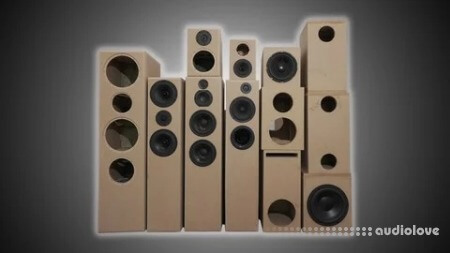
Most importantly, you will see this process applied to multiple real loudspeaker projects. This course contains 11 box designs from the design phase to the finished box: 6 subwoofers, 2 bookshelf speakers and 3 floor standing speakers. We will establish our design targets, design and build the enclosures, measure the actual drivers, create and optimize the crossovers, assemble the speakers, and finally measure the completed systems to see how closely the finished loudspeakers match our original targets.
The goal of this course is not simply to give you designs that you can copy. It is to teach you a repeatable loudspeaker design workflow that you can apply to your own drivers, enclosures, and future projects.
By the end of the DIY Audio Masterclass, you will understand not only how to build a loudspeaker, but why it works. And you will have the tools and knowledge required to take your own speaker project from an idea to a measured, optimized, finished design.
What you'll learn
home page
This course takes you through the entire loudspeaker design process, combining the essential theory with real-world measurements, simulations, and complete speaker builds.
Rather than focusing only on formulas and idealized examples, you will see how loudspeakers behave in the real world and learn how to make design decisions based on actual measured data.
We begin with the fundamentals of acoustics and loudspeaker design, giving you the knowledge needed to understand how drivers, enclosures, crossovers, and the listening environment interact.
You will then learn how to design different types of speaker enclosures, including sealed, bass-reflex, passive radiator and also 4th order and 6th order bandpass systems. We will cover driver parameters, enclosure volume, tuning frequency, ports, passive radiators, and the compromises involved in choosing the right alignment for a particular driver.
From there, we move into acoustical and electrical measurements. You will learn how to use REW (Room EQ Wizard) to measure loudspeaker drivers and finished enclosures, obtain frequency and impedance responses, perform near-field and far-field measurements, work with gated measurements, and prepare accurate data for the design process.
For multi-way speakers, we then take those real measurements into VituixCAD and design the passive crossover. You will learn how high-pass, low-pass, and band-pass filters work, how component values affect the response, and how to deal with real-world issues such as driver sensitivity, phase, impedance, baffle step, diffraction, and off-axis behavior.
Most importantly, you will see this process applied to multiple real loudspeaker projects. This course contains 11 box designs from the design phase to the finished box: 6 subwoofers, 2 bookshelf speakers and 3 floor standing speakers. We will establish our design targets, design and build the enclosures, measure the actual drivers, create and optimize the crossovers, assemble the speakers, and finally measure the completed systems to see how closely the finished loudspeakers match our original targets.
The goal of this course is not simply to give you designs that you can copy. It is to teach you a repeatable loudspeaker design workflow that you can apply to your own drivers, enclosures, and future projects.
By the end of the DIY Audio Masterclass, you will understand not only how to build a loudspeaker, but why it works. And you will have the tools and knowledge required to take your own speaker project from an idea to a measured, optimized, finished design.
What you'll learn
- Design and build complete loudspeakers from scratch, from the initial concept to the finished speaker.
- Design sealed, ported and passive radiator, 4th order and 6th order bandpass enclosures and optimize them using real-world measurements.
- Measure loudspeaker drivers acoustically and electrically using REW and prepare accurate data for crossover design.
- Design and optimize passive crossovers in VituixCAD using real driver measurements and off-axis response data.
home page
Only registered users can see Download Links. Please or login.
No comments yet